


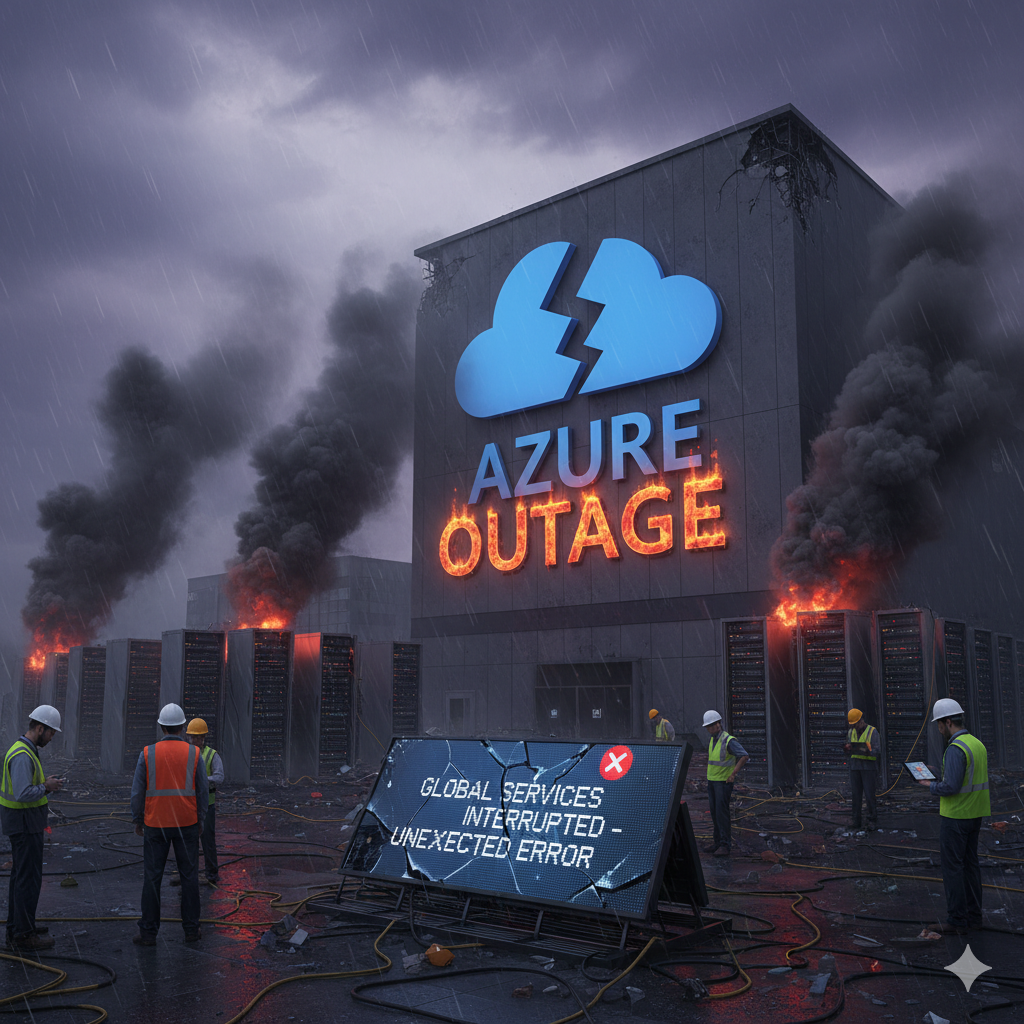
Azure Disruption in October 2025: A Detailed Study
On October 18, 2025, the global digital landscape was severely impacted by a significant disruption to Microsoft Azure services. During a critical period of approximately six hours, a series of outages affected key areas across North America and Europe, impacting everyone from small startups to large corporations. This incident was not merely an inconvenience; it served as a powerful reminder of the crucial interdependence that exists in our contemporary digital infrastructure.
In this study, we’ll analyze not only what happened that day, but also transform this situation into a valuable learning opportunity. We’ll offer you a set of practical and proactive strategies to protect your operations against potential future cloud disruptions.
What Exactly Happened? The Background of the Fall
The investigations that followed the incident, described in Microsoft’s official report, revealed a complex series of events, showing that a single failure rarely causes a crisis of such magnitude.
The Initial Spark: A Mistake in a Network Update
It all started with the automated deployment of a firmware update to network devices in one of Azure’s main regions. This update, intended to improve performance, contained a bug that went undetected during quality assurance testing. This bug caused unusual behavior in the network switches, resulting in significant packet loss and extreme latency.
The Domino Effect and the Escalation of Chaos
The initial problem was not isolated. Azure’s automation systems, designed to identify failures and redirect traffic, kicked in. However, the magnitude and nature of the network failure overwhelmed these alternative routes. This caused a domino effect, with congestion spreading to nearby regions trying to absorb the load, ultimately leading to the collapse of interconnected services.
– Affected Services: Azure Active Directory (AAD), essential for authentication, experienced severe difficulties, preventing users and applications from accessing their accounts. This, in turn, affected services such as Office 365, Azure SQL Database, and Azure App Services for a large number of customers.
– Impact on User Experience: Companies reported that their websites, mobile applications, and internal systems were completely inaccessible. E-commerce activities were disrupted, financial transactions were frozen, and remote collaboration became impossible for a large number of users.
The recovery involved a manual and extremely careful reversal of the faulty update, a process that took hours due to the need to ensure data integrity during the restoration.
Lessons Learned: How to Turn a Crisis into a Strategy
Azure’s discontinuation in 2025 highlighted that responsibility for resilience is shared. Microsoft manages the platform, while users need to design their own solutions to handle failures. This is where you can make a difference.
5 Essential Strategies to Minimize the Impact of Future Falls
Don’t wait for the next failure. Implement these crucial strategies now to develop a truly robust infrastructure.
1. Plan for Failure: The Resilience Framework
Consider that services can fail and structure your application to remain operational.
– Multi-Region Architecture: Establish an active-active or active-passive configuration across at least two geographically separated Azure regions. Use Azure Traffic Manager or Azure Front Door to intelligently route traffic and automatically switch over if one region experiences issues.
– Service Decoupling: Use asynchronous models and queues like Azure Service Bus or Queue Storage to prevent a service failure from paralyzing the entire application.
2. Implement a Proven Disaster Recovery (DR) Plan
Having a plan on paper is not enough.
– Failover Automation: Leverage services like Azure Site Recovery to automate the complete migration of your workloads (virtual machines, applications) to a secondary region.
– Frequent Drills: Conduct disaster drills or “fire drills” regularly. Disconnect services in your primary region in a controlled manner and verify that your DR is functioning properly. Practice makes perfect.
3. Foster a Culture of Proactive Monitoring and Relevant Alerts
You can’t fix what you can’t see.
– Real-time monitoring: Go beyond basic metrics. Use Azure Monitor and Application Insights to gain a detailed understanding of your application performance and integrity.
– Effective Alerts: Set up alerts that trigger at early signs of problems (e.g., increased latency, 5xx error rates) and directly notify the on-call team via channels such as SMS, email, or Microsoft Teams.
4. Improve your Security and Governance
A configuration error can be as damaging as a platform failure.
– Periodic Reviews: Although Microsoft’s failure was the initial reason, it is essential to keep your own resources and systems up to date to avoid security breaches.
– Independent and Verified Backups: Adhere to the 3-2-1 backup rule: keep at least 3 copies of your data, on 2 different types of media, and 1 located off-site. Ensure that your Azure Blob Storage or Azure SQL Database backups are in a separate region and regularly verify that you can recover them.
5. Prepare your staff and your communication channels
Resilience also has a human component.
– Emergency Communication Strategy: Establish a clear protocol for communicating with your users and customers during an outage. Transparency helps reduce frustration.
Training and Guidelines: Verify that your operations and development staff have received the necessary training on disaster recovery procedures and that documented guidelines exist for common failure situations.
Closing: Beyond the Cloud, Towards Digital Trust
The discontinuation of Azure in October 2025 did not mark the end of cloud computing, but rather a milestone in its evolution. It taught us that reliability is not simply a feature that can be toggled on, but the result of an intentional architectural process, organized management, and a focus on continuous preparedness.
By implementing the strategies mentioned above, you can transform your company from a passive observer vulnerable to system failures into a robust and empowered user capable of ensuring business continuity even when cloud providers experience disruptions. The digital future isn’t about eliminating all interruptions, but about developing systems—and teams—that can effectively address them.

No comment